Application Webinar
Perkins V Application Academy: Webinar #2
Date: March 12, 2026
This webinar provides an overview of Programs of Study, submitting local applications, reallocation of prior-year funds, and Maintenance of Effort in Perkins V. This page offers an accessible web version of the presentation content.
Webinar #1 Recap
During the February 26 webinar, participants reviewed Perkins V requirements for the local application for funding, proposed changes to local application documents, and the rationale for those changes. The session emphasized that all parts of the local application should work together to present a complete picture of how the consortium plans to use Perkins funding to support Career and Technical Education programs.
Webinar #2 Agenda
- Programs of Study
- Submitting Applications
- Reallocation Feedback and Maintenance of Effort
Objective and Expected Outcomes
Objective: The objective of this webinar is for each participant to comprehend the 2026 changes to local application documents.
Following completion of this webinar, participants will be able to:
- Identify changes to application documents
- Recall how to complete documents for their consortium
- Describe the relationship between documents
- Explain the rationale for change
Rationale for Change
- Provide clarity
- Reduce duplication
- Consolidate where possible
- Remove unnecessary information
- Strengthen the connection between the CLNA and uses of funds
- Improve the applicant experience
- Increase transparency and trust
- Address applicant feedback
A key question in this redesign process is: What can we stop doing? Another is: Is this step really necessary? The intent is to simplify the application process while keeping requirements clear and meaningful.
Local Application: 2026 Changes
- Statement of Assurances
- CLNA Results and Priorities
- Narrative
- Budget
- Programs of Study
- Perkins-Funded Positions
- Position Descriptions
- Consortium Inventory
- Improvement Plan, if necessary
Programs of Study (POS)
Why Programs of Study Matter
- Federal reporting requirements
- Public availability
- Validation of the connection with the CLNA
Minnesota Career Fields and Clusters
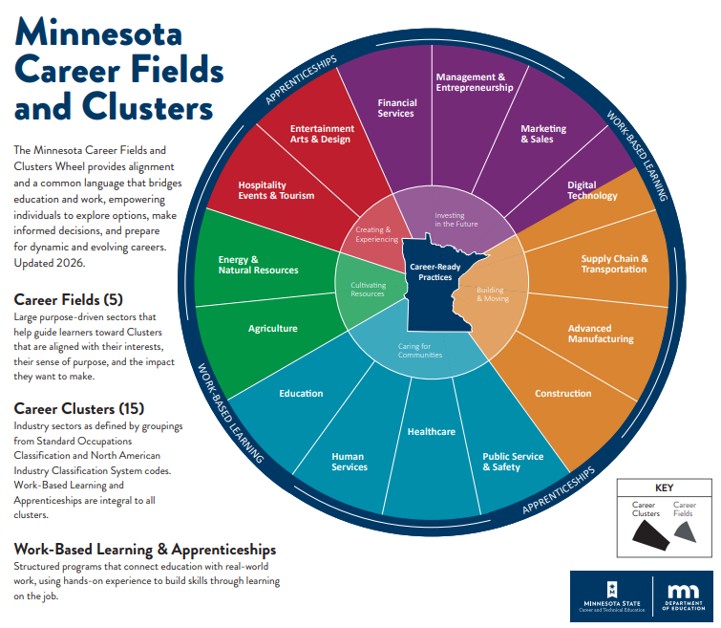 MN Career Clusters
Accessible description:
The Minnesota Career Fields and Clusters wheel is a circular framework that organizes career pathways. At the center are Career-Ready Practices, representing foundational skills for all careers.
The next layer divides careers into four broad fields:
- Investing in the Future
- Building and Moving
- Caring for Communities
- Creating and Experiencing
The outer ring includes 15 career clusters aligned to these fields. These include: Agriculture; Energy and Natural Resources; Education; Human Services; Healthcare; Public Service and Safety; Construction; Advanced Manufacturing; Supply Chain and Transportation; Digital Technology; Marketing and Sales; Management and Entrepreneurship; Financial Services; Hospitality, Events and Tourism; and Arts, Entertainment and Design.
Work-based learning and apprenticeships are emphasized as opportunities available across all career clusters.
Programs of Study Chart
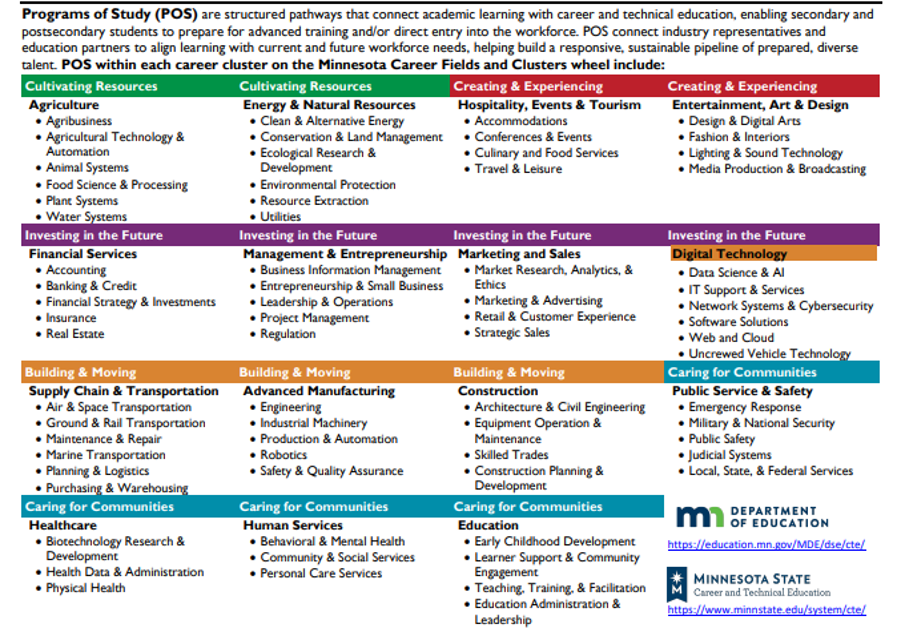
Accessible description:
This chart lists Programs of Study (POS) aligned to the Minnesota Career Fields and Career Clusters framework. Programs of Study are structured pathways that connect academic learning with career and technical education and workforce preparation.
The chart is organized by four main career fields:
Cultivating Resources
Includes Agriculture (agribusiness, animal systems, plant systems, food science) and Energy and Natural Resources (clean energy, conservation, environmental protection, utilities).
Creating and Experiencing
Includes Hospitality, Events and Tourism (accommodations, culinary services, travel) and Arts, Entertainment and Design (digital arts, fashion, media production).
Investing in the Future
Includes Financial Services (accounting, banking, investments), Management and Entrepreneurship (business management, project management), Marketing and Sales (market research, advertising, retail), and Digital Technology (data science, IT support, cybersecurity, software, web and cloud technologies).
Building and Moving
Includes Supply Chain and Transportation (air, rail, logistics), Advanced Manufacturing (engineering, robotics, automation), and Construction (architecture, skilled trades, equipment operation).
Caring for Communities
Includes Healthcare (biotechnology, health administration, physical health), Human Services (mental health, social services), Education (early childhood, teaching, leadership), and Public Service and Safety (emergency response, military, public safety, government services).
Each cluster includes multiple example pathways that represent specific career preparation options.
Programs of Study Spreadsheet: What It Is and What It Is Not
What It Is
- A place to identify your prioritized Programs of Study
- A place to identify both State-Recognized and Funding Programs of Study
What It Is Not
- It is not a place to identify all of your Programs of Study
Types of Programs of Study
- State-Recognized — Meets the seven criteria
- Funding — May not have all seven criteria
- Both State-Recognized and Funding
State-Recognized Programs of Study Criteria
- Academic, Technical, and Employability Skills
- Integrated Network of Partners
- MDE CTE Approved Program
- Minnesota State Program Approval
- Materials, Equipment, and Resources
- Authentic Work Experience
- Supported by CLNA
Programs of Study Spreadsheet Updates
- State-Recognized and Funding spreadsheets are now combined into one
- Row 1 header now says Career Cluster instead of POS
- Rows 2 through 4 include updated dropdown choices for Field, Cluster, and POS cells
- The Priority row, such as 1, 2, 3, and Reserve, has been eliminated
- Row 5 for Secondary Approved CTE Programs now requires only Program Code and Name, not each individual high school
- Row 10 adds a dropdown for Types of POS
- Row 13 for Approved Work-Based Learning Programs now requires only Program Code and Name, not each individual high school
Additional Notes on the POS Spreadsheet
- Row 6 for Postsecondary Partner Institutions does not yet include dropdowns
- Rows 7 through 9 for Postsecondary CTE Program do not yet include dropdowns
- Updates are still in process
- Some confusion remains around program alignment
Submitting Your Consortium’s Application
Minnesota Perkins Portal in Microsoft Teams
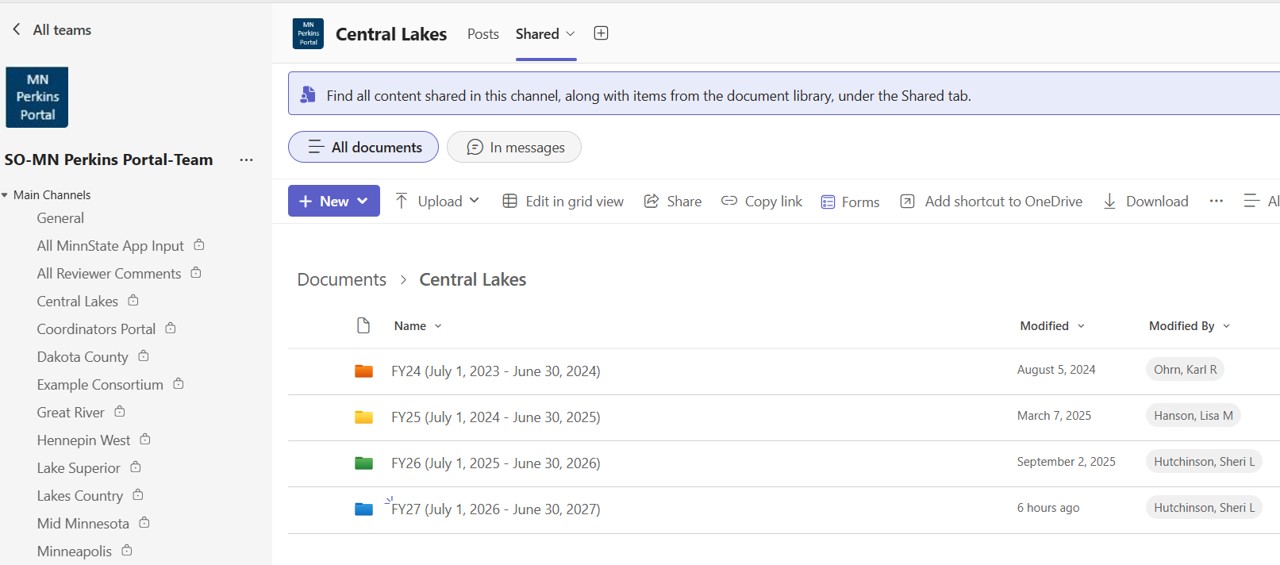
Accessible description:
This screenshot shows the Minnesota Perkins Portal within Microsoft Teams. The Central Lakes consortium channel is open, and the Shared tab is selected. A document library is visible with folders labeled by fiscal year, including FY24, FY25, FY26, and FY27. These folders are used to organize grant applications and related materials.
The left navigation panel lists multiple consortium channels, many of which are marked as private, indicating restricted access. The interface also includes options to upload, share, and manage documents within the Teams environment.
Reallocation of Prior-Year Funds
Perkins V, Section 133(b)
Perkins Reallocation Comparison 2020 to 2026
Summary of chart: Total reallocation funding generally increased from 2020 through 2026, with a temporary decline in 2024 and 2025 before rising sharply in 2026.
| Year | Total Reallocation |
|---|---|
| 2020 | $627,182.93 |
| 2021 | $764,789.62 |
| 2022 | $1,548,190.00 |
| 2023 | $1,852,200.00 |
| 2024 | $1,762,180.29 |
| 2025 | $1,522,881.23 |
| 2026 | $2,506,300.67 |
Comparison of Perkins Reallocation by Category, 2020 to 2026
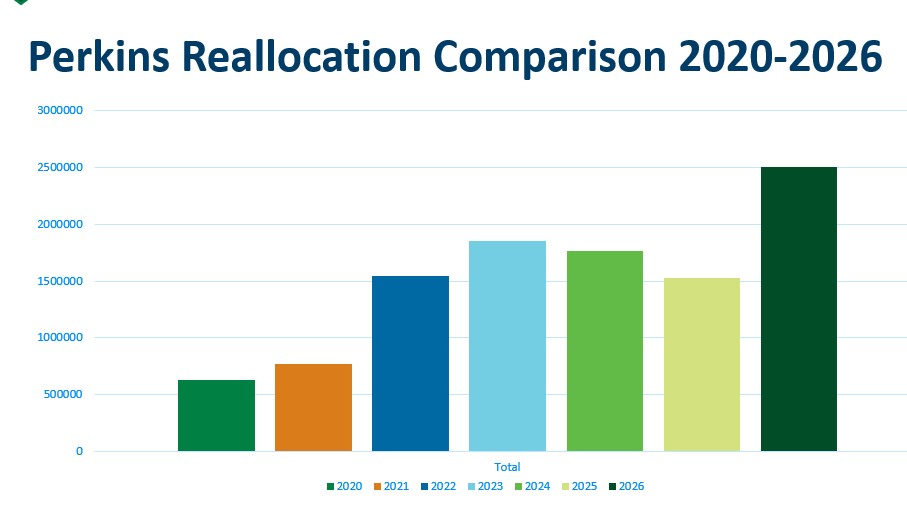
Accessible Description: This bar chart displays total Perkins reallocation funding from 2020 through 2026. Funding begins at approximately $627,000 in 2020 and increases to about $765,000 in 2021. It rises significantly to around $1.55 million in 2022 and peaks at about $1.85 million in 2023. Funding then decreases slightly to approximately $1.76 million in 2024 and $1.52 million in 2025. In 2026, funding increases sharply to about $2.5 million, representing the highest value shown. Overall, the trend shows growth over time with a temporary decline before a large increase in the final year.
| Year | Secondary Basic | Secondary Reserve | Postsecondary Basic | Postsecondary Reserve |
|---|---|---|---|---|
| 2020 | $185,122.75 | $42,999.29 | $321,802.15 | $77,258.74 |
| 2021 | $361,028.39 | $20,271.46 | $288,673.73 | $94,816.04 |
| 2022 | $866,302.24 | $132,063.86 | $475,183.93 | $74,639.92 |
| 2023 | $959,555.89 | $204,551.95 | $535,042.93 | $153,049.05 |
| 2024 | $660,112.61 | $273,171.45 | $659,409.36 | $169,486.87 |
| 2025 | $535,709.24 | $170,580.64 | $600,996.22 | $215,595.15 |
| 2026 | $683,893.19 | $231,376.53 | $1,252,970.17 | $338,060.78 |
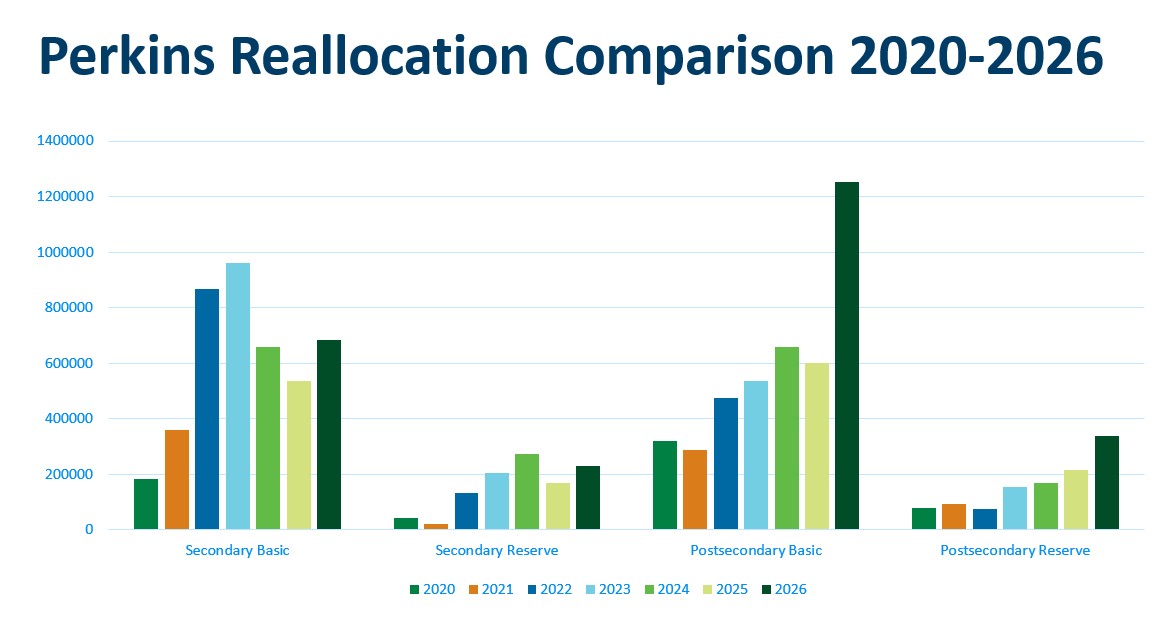
Summary of Chart:
Comparison Perkins Reallocation Secondary and Postsecondary 2020–2026. This grouped bar chart compares Perkins reallocation funding from 2020 through 2026 across four categories: Secondary Basic, Secondary Reserve, Postsecondary Basic, and Postsecondary Reserve.
Secondary Basic funding increases overall from approximately $185,000 in 2020 to about $684,000 in 2026, with fluctuations across the years. Secondary Reserve remains the smallest category, growing from under $50,000 in 2020 to about $231,000 in 2026.
Postsecondary Basic shows the most significant growth, rising from about $322,000 in 2020 to approximately $1.25 million in 2026. Postsecondary Reserve increases from roughly $77,000 in 2020 to about $338,000 in 2026.
Overall, all categories show upward trends over time, with the most notable increase occurring in Postsecondary Basic funding in 2026.
Maintenance of Effort
Perkins V Section 211(b)(1)(A)
What Is Maintenance of Effort?
The Maintenance of Effort requirement in Perkins V is a fiscal safeguard designed to ensure that states and local educational agencies do not reduce their own spending on Career and Technical Education while continuing to receive federal Perkins funds.
Core Rule
State and local funding must not drop. A state must demonstrate that its fiscal effort per student or its aggregate state and local expenditures for CTE in the preceding fiscal year were at least equal to or greater than those in the second preceding fiscal year.
What Happens if a State Fails to Meet Maintenance of Effort?
If a state's CTE funding level falls below the required threshold, the U.S. Department of Education reduces the Perkins grant by the same percentage as the state's drop in CTE spending.
Summary
- Perkins V requirements
- 2026 changes to Perkins local application documents
- Rationale for change
- Submitting the local application
- Reallocation and Maintenance of Effort
Contact Information
Minnesota State
30 East 7th Street, Suite 350
St. Paul, MN 55101-7804
Minnesota Department of Education
400 Stinson Boulevard Northeast
Minneapolis, MN 55413
Thank you.