Minnesota Programs of Study
A Program of Study is defined under the Perkins V Act as a coordinated, non-duplicative sequence of academic and technical content at the secondary and
A State-Recognized Program of Study
Once a consortium has established a program of study, there are seven minimum criteria that must be met to become a State-recognized Program of Study. They are:
- Course standards accurately align to the academic, technical, and employability skills learners must master for entry and success in a given career pathway: Content standards, frameworks and competencies that define what students are expected to know and be able to do to enter and advance in college and/or careers comprise the foundation of a POS.
- Program of Study incorporates active involvement from an integrated network of partners: Ongoing relationships among education, business, and diverse community stakeholders bolster POS design, implementation, evaluation and maintenance.
- Secondary program(s) meets MDE program approval requirements and incorporate courses that lead to postsecondary credits/credentials: Secondary programs have appropriately-licensed teachers, advisory committees, develop and ensure access to equitable student leadership opportunities, and provide career exploration activities leading to postsecondary credits/credentials.
- Postsecondary academic program meets Minnesota State board policy and Higher Learning Commission requirements: A cohesive arrangement of college-level credit courses and experiences, designed to accomplish predetermined objectives, lead to the awarding of a degree, diploma, or certificate.
- Materials, Equipment, and Resources: Facilities, equipment, technology and materials used in the program of study reflect current workplace, industry and/or occupational standards and practices for installation, use, maintenance, and safety.
- Incorporates authentic work experiences at the secondary and/or postsecondary level that are valued by industry: POS engages students in authentic work-based learning experiences that demonstrate progressive occupational learning aligned to industry workforce needs.
- Program of Study development, improvement and advocacy are supported by findings from a comprehensive local needs assessment: Systems and strategies for gathering, analyzing, and disseminating needs assessment data are effective for guiding the improvement of POS, and available in plain language to enhance use by stakeholders for POS advocacy.
Use the Program of Study Search tool to explore career and technical education pathways in your high school or college.
Introduction to Career Clusters
The National Career Clusters® Framework provides a consistent way to organize Career and Technical Education (CTE) programs and connect learning to the world of work. It serves as a shared structure that helps educators, students, and workforce partners understand how different careers are grouped and how they relate to one another.
Career clusters group occupations and industries based on shared knowledge and skills, making it easier for learners to explore career options, identify areas of interest, and build pathways toward high-demand careers.
The modernized framework includes 14 Career Clusters, 72 sub-clusters, and cross-cutting career-ready practices, creating a flexible system that aligns education with workforce needs and supports learners at all stages of their career journey.
By organizing careers into clusters, this framework helps:
- Connect education and industry
- Support career exploration and planning
- Align secondary, postsecondary, and workforce systems
- Ensure learners develop both technical and transferable skills
Minnesota Career Fields and Clusters
The Minnesota Career Fields and Clusters framework provides a common way to organize Career and Technical Education pathways. It groups related occupations, industries, and programs for dynamic and evolving careers.
This framework helps learners, educators, and workforce partners better understand how careers connect through broad career fields, related career clusters, and Career-Ready Practices that support success across all areas.
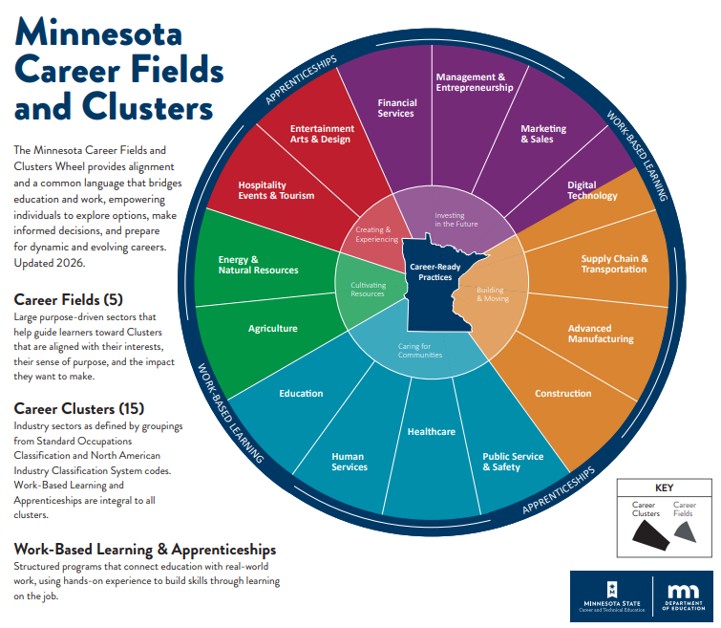
Complete List of Career Clusters
The following list represents all career clusters included in the Minnesota framework:
- Agriculture
- Energy and Natural Resources
- Arts, Entertainment and Design
- Hospitality, Events and Tourism
- Education
- Human Services
- Healthcare
- Public Service and Safety
- Construction
- Advanced Manufacturing
- Supply Chain and Transportation
- Financial Services
- Management and Entrepreneurship
- Marketing and Communications
- Digital Technology
Career Fields and Clusters
The Minnesota Career Fields and Clusters framework includes five career fields and fifteen career clusters. Each cluster represents a group of related careers that share common knowledge and skills.
Investing in the Future
- Financial Services
- Management and Entrepreneurship
- Marketing and Communications
- Digital Technology
Building and Moving
- Supply Chain and Transportation
- Advanced Manufacturing
- Construction
Caring for Communities
- Healthcare
- Human Services
- Education
- Public Service and Safety
Creating and Experiencing
- Hospitality, Events and Tourism
- Entertainment, Arts and Design
Cultivating Resources
- Agriculture
- Energy and Natural Resources
Career-Ready Practices
Career-Ready Practices are broad skills and behaviors that are applied within each career field and support success in every career cluster.
Career Fields (5)
The framework is organized into five broad career fields that group related industries and occupations.
Investing in the Future
- Financial Services
- Management and Entrepreneurship
- Marketing and Communications
- Digital Technology
Building and Moving
- Supply Chain and Transportation
- Advanced Manufacturing
- Construction
Caring for Communities
- Healthcare
- Human Services
- Education
- Public Service and Safety
Creating and Experiencing
- Hospitality, Events and Tourism
- Entertainment, Arts and Design
Cultivating Resources
- Agriculture
- Energy and Natural Resources
Career Clusters (15)
Career clusters are narrower groupings within the career fields. These clusters help learners explore related occupations and identify pathways connected to their interests and goals.
- Clusters organize careers with shared knowledge, skills, and experiences.
- Clusters support career exploration, planning, and program design.
- Clusters help connect secondary, postsecondary, and workforce pathways.
Work-Based Learning and Apprenticeships
Work-Based Learning and Apprenticeships are integral to all career fields and career clusters. These experiences help learners apply classroom knowledge in real-world settings and strengthen connections between education and employment.
Learn More
To learn more about the national Career Clusters framework, visit National Career Clusters Framework .
- Career Clusters Framework CIP/SOC Crosswalk
- State-Recognized Programs of Study User Guide