Resources and Guides
Resources and Guides brings together everything needed to support a successful transition to Workday as part of NextGen. Designed as a central hub, this space connects learning, training, and reference materials to help employees build knowledge, stay informed, and confidently navigate new ways of working.
The experience begins before formal training, encouraging early engagement through foundational tools like glossaries, project updates, and campus communications that build shared understanding and familiarity. From there, role-based training provides a structured and flexible learning path as we get closer to go-live.
As the project progresses, continuously updated reference materials ensure access to the most current guidance. Together, these resources are designed to empower employees to make the most of Workday.
At its core, this site supports one goal: helping every learner feel prepared, confident, and ready to succeed at using Workday.
Your Workday Learning Journey Starts Now
Preparing for Workday begins well before formal training. As part of NextGen, employees are encouraged to start building familiarity and confidence early through a variety of learning and engagement opportunities.
This journey includes exploring the Workday Student glossary to understand key terms and concepts, attending town halls to hear updates and see progress in action, and staying informed through the NextGen newsletter and project communications. Employees can also engage directly by participating in project activities, providing feedback, and connecting with campus and systemwide partners. Collectively we all play a role in the shared success of operating more as one Minnesota State - including reviewing messages from NextGen, attending NextGen informational and learning events, translating learning about NextGen into preparing local operations for needed changes, completing NextGen go-live learning, and supporting each other as we go through this transition for the sake of our learners and the viability of our future"
These early steps help build a shared understanding, reduce uncertainty, and create a strong foundation—so when role-based training begins, you’re ready to learn, apply, and succeed.
Workday Training
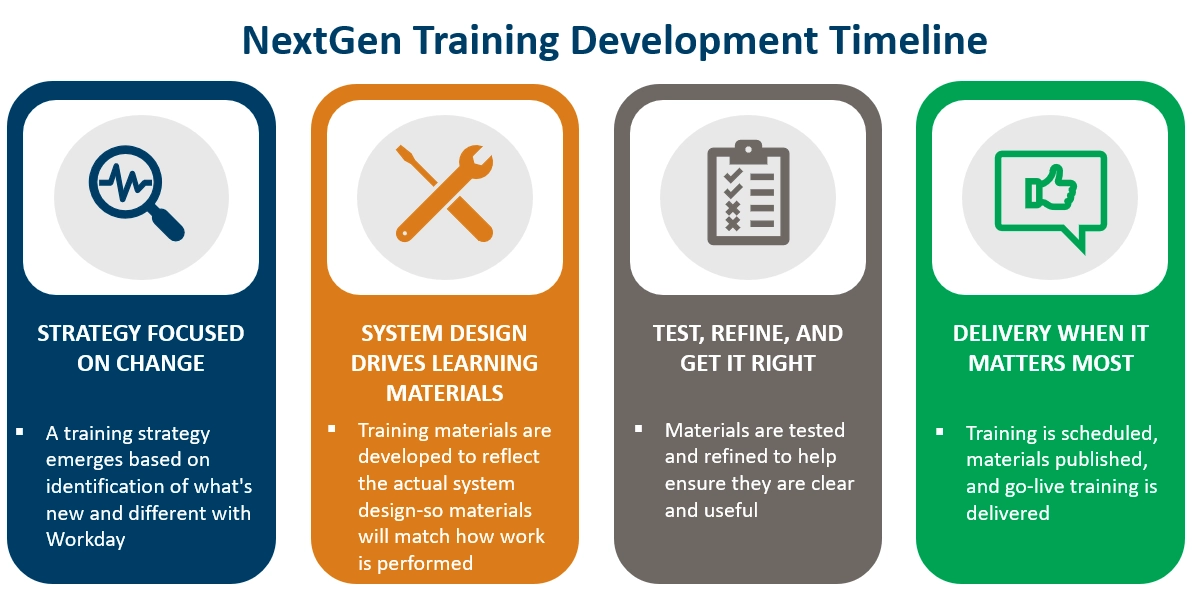
Workday Student training will be designed to prepare Minnesota State students and employees with the knowledge and skills needed to successfully use Workday. The approach is role-based, meaning training is tailored to the specific responsibilities and system access of each user thus ensuring the right people receive the right training at the right time.
Training is developed using a structured, proven methodology grounded in adult learning principles. Content is created in collaboration with subject matter experts and continuously refined through review, testing, and feedback to ensure it is practical, relevant, and easy to apply. Employees will be prepared for go-live with targeted training and supported afterward through updated resources and ongoing learning opportunities.
Flexible, Blended Learning Experience
To support a wide range of learners and roles, training will utilize a blended training model that combines multiple learning options, including:
- Instructor-led training for hands-on, high-impact work
- Virtual sessions for guided learning and demonstrations
- Self-paced online courses for flexible learning
- A library of job aids and reference guides
This flexible approach allows students and employees to learn in ways that best fit their role, experience level, and schedule.
Train-the-Trainer Model
Training will be delivered through a train-the-trainer approach, where selected staff from across Minnesota State are prepared to lead training locally. This model builds campus expertise, supports consistency, and provides accessible and relevant training for each campus.
Aligned with the Workday Timeline
Training will be delivered in alignment with the Workday implementation timeline, making sure resources are available when needed and support a smooth transition. From early planning through deployment and beyond, training evolves alongside the project to meet changing needs.
The Architect and Configure and Test phase of NextGen will define how the system is built, configured, and used—providing the clarity needed to develop effective training. Because training must reflect the final design, it will follow once these decisions are confirmed to ensure accuracy and relevance for learners.
Minnesota State employees will receive further details on their specific, role-based training plan as the project progresses.
Workday is the modern platform used across Minnesota State to manage finance, human capital management (HCM), and—eventually—student processes. As part of the NextGen transformation, training resources will be designed to provide clearer, more accessible, and up-to-date information.
Once fully updated, this site will serve as a central hub for Workday reference guides and job aids. Materials will be continuously updated to reflect system enhancements and evolving processes to help ensure access to the most current materials.
Minnesota State employees interested in HCM and Finance reference guides should visit the Workday Training Knowledge Base for additional information.
The journey to fully utilizing Workday begins with first learning the terminology and language of Workday. As a modern, integrated platform, Workday introduces new concepts, structures, and ways of working that may feel unfamiliar at first. These glossaries are designed to help you build a shared understanding across Finance, Human Capital Management (HCM), and Student areas, making it easier to navigate the system. By becoming familiar with Workday language, you’ll be better equipped to take full advantage of Workday’s capabilities.
- Workday Finance Glossary
- Workday Human Capital Management Glossary (coming soon)
- Workday Student Glossary
What is the NextGen Project?
The NextGen Project is a Minnesota State initiative to modernize its digital systems by replacing the outdated Integrated Statewide Record System (ISRS) with Workday, a modern, mobile-friendly, and student-centered technology. More than just a system upgrade, NextGen aligns all 54 campuses under one unified platform, making education more accessible, equitable, and seamless—from application to graduation.
Why is Minnesota State moving away from the Integrated Statewide Record System (ISRS)?
The Integrated Statewide Record system (ISRS) has served Minnesota State for decades, but it no longer meets today’s administrative and student needs. By replacing it with Workday, Minnesota State will build a modern technology landscape that supports every step of the student journey—from application to graduation and beyond.
How does NextGen connect to Equity 2030?
Equity 2030 is the Minnesota State goal to eliminate educational equity gaps across all colleges and universities by the year 2030. The NextGen Project plays a critical role in achieving this vision by closing technology access gaps that often stand in the way of student success. By introducing consistent, accessible tools for every learner, NextGen ensures that all students—regardless of background, location, or resources—have the same opportunity to thrive.
Why was Workday chosen?
Workday delivers a modern, unified platform designed to make life easier for students, faculty, and staff. Operating from a solution will streamline operations across finance, human resources, and student services, creating efficiencies that allow more focus on supporting student success. As a cloud-based platform, Workday enables continuous improvement and functionality updates over time.
What are the benefits for students?
Workday will create a simpler, more connected experience for students. They’ll be able to track progress, manage financial aid, register for courses, and interact with advisors—all from a single platform that works seamlessly on mobile devices.
What are the benefits for faculty and staff?
Faculty and staff will gain significant advantages from the transition to Workday. The new system will provide better reporting tools at both the institutional and system levels, enabling data-driven decision-making. Workday also brings greater transparency to workflows and approvals, giving employees clearer visibility into processes from start to finish. Academic functions will be strengthened through streamlined advising, degree audits, and credit transfer tools, making it easier to support students throughout their academic journey. In addition, faculty and staff will benefit from improved efficiencies in the management of recruiting, admissions, records, and curriculum.
What functional areas will Workday Student include?
Workday Student is being implemented across six functional areas:
- Academic Foundation – academic structure, programs of study, calendars
- Recruiting & Admissions – prospect management, application submission, admissions evaluation
- Records & Curriculum Management – course registration, academic records, policies
- Advising – requirements, degree audit, advising appointments, credit transfer
- Financial Aid – ISIR processing, awards, packaging, disbursement, SAP, work study
- Student Financials – student charges, student payment and payment plans, third-party billing and payments, student waivers, student refunds, tax reporting, and related processes
What is the Student Worker Project and how does it fit with the Workday Student implementation?
The Student Worker project aims to enhance consistency and compliance, improve the student employee experience, and reduce administrative burden and institutional risk. The project brings all student employees into standardized Workday business processes, including:
- Hiring
- Time tracking
- Payroll
Together, these efforts represent a systemwide transformation of student employment by integrating student workers and related processes into the Workday ecosystem. This alignment connects student employment with existing Workday Human Capital Management (HCM) and the future Workday Student platform. Full implementation is targeted for fall 2029.
When will Workday go live?
The Workday Student implementation will roll out in phases, between fall 2028 and fall 2029. Each functional area will have specific timelines to ensure a smooth transition and minimize disruption. See the timeline section for more details.