Project Scope and Timeline
Transforming How We Work and Support Students
The NextGen initiative is a multi-year transformation designed to modernize systems, improve experiences, and better support students and employees across all 33 institutions.
At the center of this work is Workday—a unified, cloud-based platform that connects human resources, finance, and student systems into one modern ecosystem.
Minnesota State has already reached major milestones in its Workday journey.
- March 2024 – Workday Adaptive Planning launched
- July 1, 2024 – Workday Human Capital Management (HCM) and Finance went live
What’s Next: Workday Student and Student Employment
Launched in December 2024, Workday Student will replace ISRS and transform how Minnesota State supports students across their entire journey. Workday Student connects the full student lifecycle—from application to graduation—into one system.
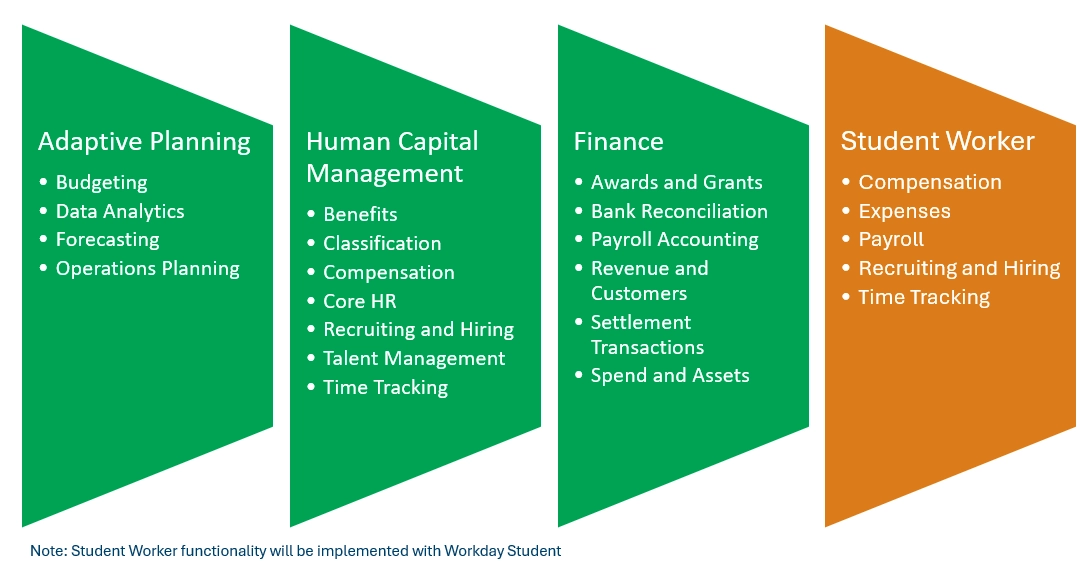
The Workday journey at Minnesota State began with the launch of the Workday Adaptive Planning module in March 2024. This was followed by the implementation of Workday Human Capital Management (HCM) and Workday Finance on July 1, 2024.
Together, these modules—integrated with cloud-based and mobile capabilities—deliver powerful data analytics and broaden opportunities for Minnesota State to advance Equity 2030 strategic goals. As part of the Student Phase, Workday will also be configured to support student workers by streamlining hiring, time tracking, and payroll processes.
Human Capital Management (HCM)
Workday HCM provides Minnesota State with a unified, cloud-based platform to manage its workforce across all colleges and universities. It consolidates core areas such as:
- Talent management
- Recruiting and hiring
- Payroll and benefits
- Time tracking
This comprehensive system enhances efficiency and consistency across the system. Additional support and resources are available through the HR Connect site and on the Workday Training Knowledge Base.
Finance
Workday Finance introduces a modern, integrated financial management solution designed to improve efficiency and strengthen data-driven decision-making. By enabling more effective allocation of resources, the platform directly supports student success and enhances the student experience.
The Finance Division provides guidance and support to all colleges and universities, as well as system office. More details, along with helpful Workday Finance process resources and EIB documentation, are available on the Finance Connect site and the Workday Training Knowledge Base.
In December 2024, Minnesota State officially began the implementation of Workday Student, a new student information system that will replace the Integrated Statewide Record System (ISRS). This milestone marks the next phase of the NextGen mission to enhance the student experience and streamline business processes across student services, academic affairs, finance, and human capital management.
A Modern, Unified System
Workday Student is a cloud-based lifecycle application that unifies student service applications and business processes into one platform. It provides real-time data, a modern interface, and powerful engagement tools designed to guide and support students at every step of their journey. For employees, it delivers improved functionality, stronger data and analytics, and stronger systemwide policy and process alignment—all to ensure a more consistent and effective student experience. While implementing Workday Student, related Policy and Process Alignment (PPA) work, Companion Projects, and Student Worker configuration are crucial to fully enabling the digital transformation of Minnesota State.
Workday Student Functional Areas
Workday Student is divided into several functional areas: Academic Foundation, Advising, Financial Aid, Recruiting and Admissions, Records and Curriculum Management, and Student Financials. A functional area is built around policy and procedure, processes, and tasks related to each of the six different Workday Student modules. Subject matter experts in these areas from across Minnesota State are actively participating throughout each stage of the project.
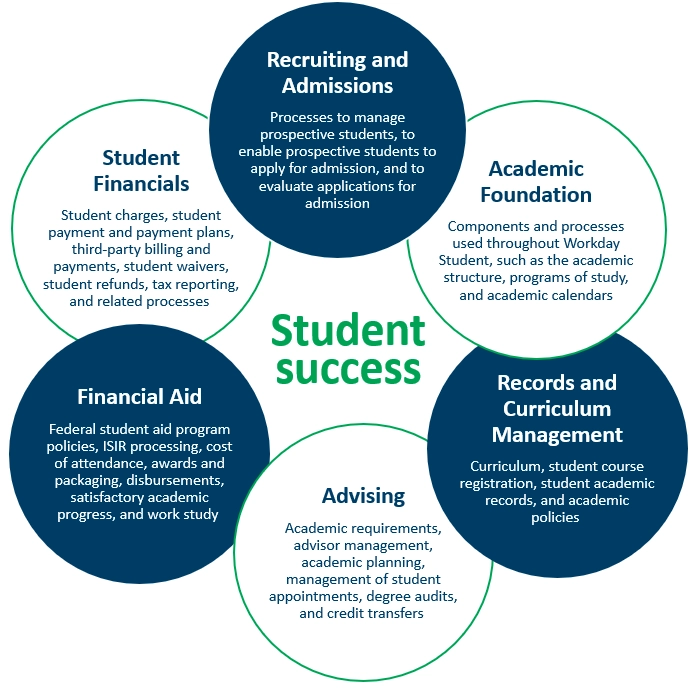
Academic Foundation – components and processes used throughout Workday Student, such as the academic structure, programs of study, and academic calendars
Advising – academic requirements, advisor management, academic planning, managing student appointments, degree audit, and credit transfer
Financial Aid – federal student aid program policies, ISIR processing, cost of attendance, awards and packaging, disbursements, satisfactory academic progress, and work study
Recruiting and Admission – processes to manage prospective students, to enable prospective students to apply for admission, and to evaluate applications for admission
Records and Curriculum Management – curriculum, student course registration, student academic records, and academic policies
Student Financials – student charges, student payment and payment plans, third-party billing and payments, student waivers, student refunds, tax reporting, and related processes
The Student Phase of NextGen is a multi-year journey that will transform the way Minnesota State supports students. Beginning with phased go-lives in Fall 2028, this effort goes beyond a technology upgrade—it represents a reimagining of the student experience, ensuring that every step of the higher education journey is more connected and consistent.
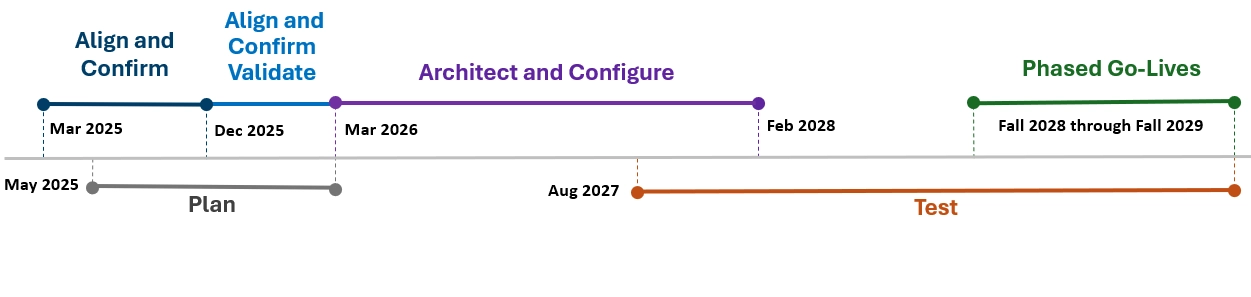
Align and Confirm: March 2025 – November 2025
As part of the Align and Confirm stage, project teams created a prototype using data from Riverland Community College (college) and Minnesota State University Moorhead (university). These institutions were selected because their data reflects key characteristics such as enrollment size, academic program variety, multi-institutional campuses, athletic programs, and student housing.
Workday used this data to build a foundational prototype, allowing for demonstration of functionality and testing. Importantly, the prototype is not a fully configured version of Workday Student and is not based on the business processes of either of the data donor institutions. Instead, it provides a way to validate student-focused business processes and see Workday functionality that will serve Minnesota State learners. All institutions had the opportunity to provide feedback at prototype review workshops conducted during the Align and Confirm Validate stage. During this same stage, other efforts move forward in parallel, such as Companion Projects and Policy and Process Alignment.
Plan Stage: May 2025 – February 2026
During the Plan stage, the project team—together with subject matter experts from across Minnesota State met with Workday to share how we currently serve students. These discussions informed prototype decisions, highlighted business process alignment needs, identified functionality gaps, and explored new ways to deliver a seamless student experience. The goal of this stage was to help Workday understand current practices and processes, and provide the insights needed to guide the next phases of the project.
Align and Confirm Validate: December 2025 – February 2026
During Align and Confirm Validate Phase, the prototype design was broadly reviewed through Prototype Review Workshops. These workshops served as a key campus engagement opportunity, providing institutions the opportunity to review the early Workday Student design, validate business process decisions, identify gaps, and deepen their understanding of Workday functionality. The goal was to refine the prototype through institutional feedback and ensure alignment across campuses.
Prototype Review Workshops offered all institutions full-day interactive sessions to review the student life cycle from both student and employee perspectives. These sessions demonstrated Workday’s base functionality, highlighted improvements and efficiencies, and identified areas needing further attention. This stage was designed to minimize risk by sharing prototype information early, confirming baseline requirements, and preparing campuses for change. To view highlights of information covered in the prototype review workshops in February 2026, Minnesota State employees can visit the NextGen Showcase site.
Architect and Configure: March 2026 – February 2028
The Architect and Configure stage establishes the baseline configuration for all institutions, incorporating feedback from prototype review workshops, planning sessions, and ongoing campus engagement. Subject matter experts from each functional area will participate at different points throughout the process.
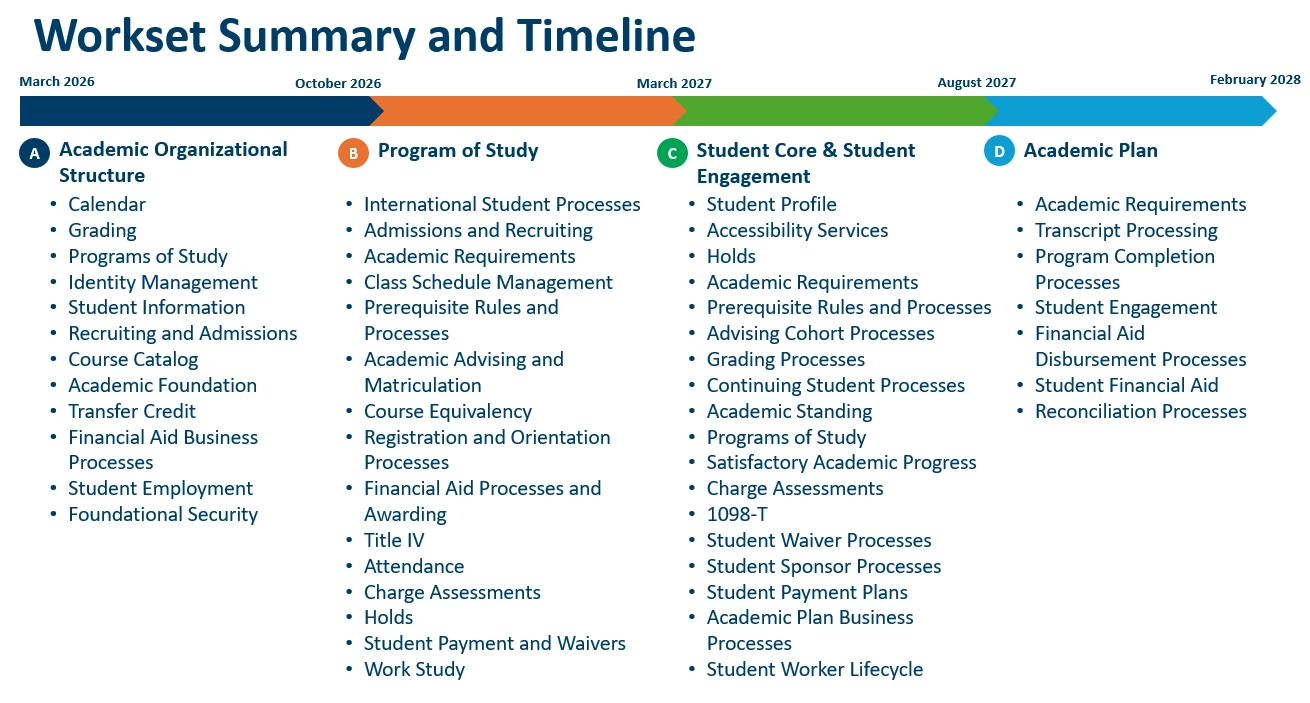
This stage is organized into four worksets, each with defined deliverables and an iterative cycle of design, configuration, testing, and validation. Policy and Process Alignment (PPA) decisions are integrated into each workset, with timely completion essential to avoid delays in subsequent phases.
Architect and Configure Stage by Workset
- Workset A (March 2026 to October 2026): includes academic organizational structure, calendar, grading, programs of study, identity management, student information, institutional information, recruiting and admissions, course catalog, academic foundation, transfer credit, financial aid business processes, student employment, and foundational security.
- Workset B (October 2026-March 2027): includes programs of study, international student processes, admissions and recruiting, academic requirements, class schedule management, prerequisite rules and processes, academic advising and matriculation, course equivalency, registration and orientation processes, financial aid processes and awarding, Title IV, attendance, charge assessments, holds, student payment and waivers, and work study.
- Workset C (March 2027-August 2027): includes student core and student engagement, student profile, accessibility services, holds, academic requirements, prerequisite rules and processes, advising cohort processes, grading processes, continuing student processes, academic standing, programs of study, satisfactory academic progress, charge assessments, 1098-T, student waiver processes, student sponsor processes, student payment plans, and academic plan business processes.
- Workset D (August 2027-February 2028): includes academic plan, academic requirements, transcript processing, program completion processes, student engagement, financial aid disbursement processes, student financial aid, and reconciliation processes.
The primary objectives are to build a shared understanding of the business needs of Minnesota State and determine how Workday will be configured to meet them. Through this work, institutions will make key design and alignment decisions as well as help support Workday configurations. Prior to the Test Phase, functionality within each workset will be tested with the help of institutional subject matter experts.
Test: August 2027 – Fall 2029
Testing helps ensure Student Employment and Workday Student configurations, integrations, and reports meet the needs of Minnesota State. There are two testing cycles during the Architect and Configure stage; functional unit testing and lifecycle testing. Functional unit testing occurs throughout each workset and began in April 2026. During the test stage of the project, end-to-end, mock semester, and user experience review testing will occur. The test stage begins in mid-to-late 2027 and goes through the final go-live in fall 2029. Each testing cycle has specific objectives, conditions, and entry/exit criteria that must be met before advancing toward go-live. All institutions will actively participate in testing the functionality and business processes configured in earlier stages.
Phased Go-Lives (Move to Productions): Fall 2028 – Fall 2029
Workday Student go-live milestones follow the student lifecycle, allowing for a phased, student-centered transition aligned to the academic year. The first users will be Fall 2029 applicants, who can begin applying in September 2028 with Milestone 1. Fall 2028 students will first engage with Workday during financial aid awarding in Fall 2028 (Milestone 2). In Spring 2029, current students will transition key activities like course registration and degree completion tracking to Workday (Milestone 3). By early Summer 2029, students will begin making payments in Workday (Milestone 4a), and by late Summer 2029, they will receive grades and access transcripts—completing the transition to Workday as the official system of record.
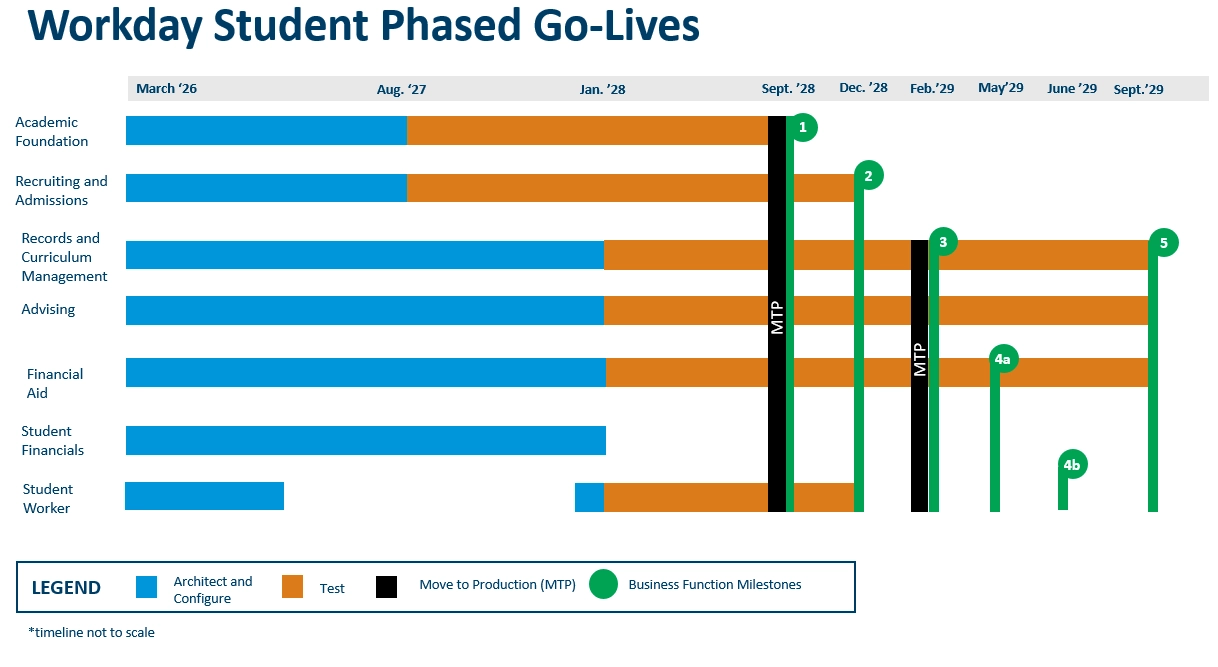
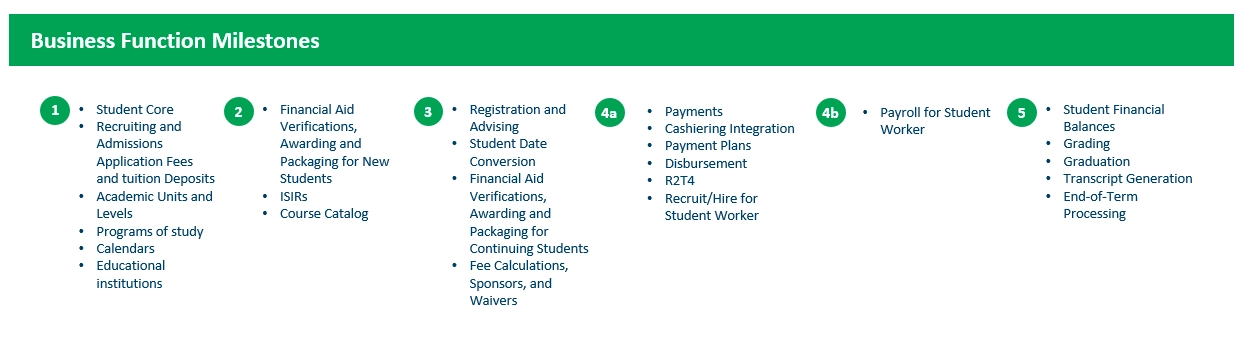
Business Function Milestone 1: includes student core, recruiting and admissions, application fees and tuition deposits, academic units and levels, programs of study, calendars, and educations institutions
Business Function Milestone 2: includes financial aid verifications, awarding and packaging for new students, ISIRs, and course catalog
Business Function Milestone 3: includes registration and advising, student data conversion, financial aid verifications, awarding, and packaging for continuing students, fee calculations, sponsors, and waivers.
Business Function Milestone 4a: includes payments, cashiering integration, payment plans, disbursement, R2T4, recruiting and hiring of student employees.
Business Function Milestone 4b: includes payroll for student employees.
Business Function Milestone 5: student financials balances, grading, graduation, transcript generation, end-of-term processing
After each go-live, there will be dedicated support to aid faculty, staff, and students feel confident using Workday and other NextGen tools. This support will focus on helping users adapt, answering questions, and addressing challenges as they arise. In addition, Workday will offer extended care services for areas that were deployed earlier, providing extra reassurance and guidance throughout the transition.
 The Student phase of NextGen includes two closely related projects: Workday Student and Student Employment. Workday Student implements a modern student information system, while Student Employment brings all student employees into standardized Workday business processes, including hiring, time tracking, and payroll.
Together, these efforts represent a systemwide transformation of student employment by integrating student employees and related processes into the Workday ecosystem. This alignment connects student employment with existing Workday Human Capital Management (HCM) and the future Workday Student platform. Full implementation is targeted for fall 2028.
The Student Employment initiative aims to enhance consistency and compliance, improve the student experience, and reduce administrative burden and institutional risk. To make this possible, the initiative also includes the policy and process alignment and companion projects that are critical to completing the digital transformation of Minnesota State.
Transforming Student Employment with NextGen
The Student Employment initiative is more than a recruiting and hiring solution—it’s a streamlined, student-centered platform designed to connect campus employment with both academic goals and career development. Drawing from best practices at peer institutions, the benefits extend across campuses, helping faculty, staff, and students save time, reduce stress, and create more meaningful employment experiences.
Key Benefits
- A single, common student employment lifecycle across all 33 colleges and universities
- Consistent practices for recruiting, hiring, onboarding, time entry, payroll, and separation
- Shared job profiles, compensation structures, and approval workflows
- Improved and consistent student experience
- One centralized, mobile-friendly system for job search, applications, onboarding, time tracking, and pay
- Faster hiring and onboarding through digital offers and automated workflows
- More equitable and transparent hiring and pay practices across campuses
- Reduced risk and increased compliance
- Built-in controls for eligibility, approvals, and documentation
- Audit-ready records and reduced reliance on manual, paper-based processes
- Improved alignment with regulatory requirements (e.g., payroll, Minnesota Paid Leave, international student employment)
- Elimination of fragmented systems and duplicate data entry
- Direct integration between recruiting, core employment data, and payroll
- Improved reporting for human resources, business offices, and financial aid
Expanded Role of Human Resources
Human Resources will govern student employment within Workday, similar to state employee management. Campus HR offices will play a more direct role in student hiring, position management, and compliance. New security roles and training will be required for campus staff.
New Tools and Ways of Working
- Student employee recruiting will move into Workday, replacing or supplementing tools such as Handshake – which will be utilized for advertising only
- Student payroll will transition to a single integrated process within Workday
- Campuses will adapt to shared workflows for approvals, documentation, and reporting
- Significant change for staff who currently manage student employment outside Human Resources or across multiple systems
- Ongoing training, communication, and support will be essential for successful adoption
Implementation Approach
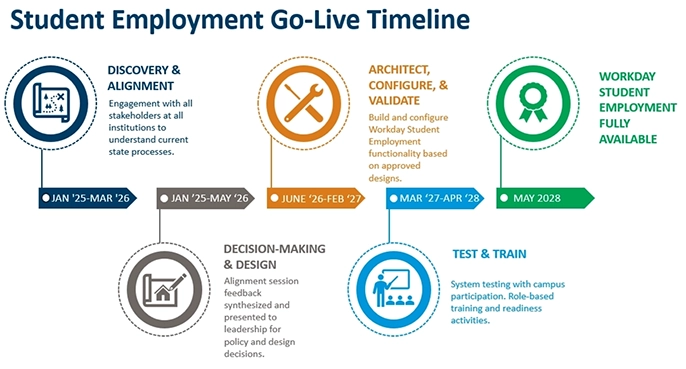
January 2025-March 2026: Discovery and Stakeholder Alignment
Engaged with all campuses to understand current-state processes, risks, and requirements. Conducted alignment sessions with subject matter experts across recruiting, payroll, and core HR functions. Identified which processes must be standardized and where limited flexibility is necessary.
January 2025-May 2026: Decision-Making and Design
Synthesized campus input and presented to executive leadership to inform policy and design decisions.
June 2026-February 2027: Architecture, Configuration, and Validation
Build and configure Workday Student Employment functionality based on approved designs. Conduct prototype reviews and validation sessions with campus stakeholders. Refine configurations through an iterative process to address identified risks and operational needs.
March 2027-April 2028: Testing, Training, and Deployment
Perform system testing with campus participation. Deliver role-based training and readiness activities. Prepare for deployment through a phased approach leading to full go-live aligned with Workday Student.
May 2028 and Beyond: Sustainment and Continuous Improvement
Provide ongoing governance, support, and enhancement post-implementation. Maintain continuous collaboration with campuses to support adoption, stability, and long-term success.
The Workday Student Employment initiative is a foundational change that modernizes student employment across Minnesota State. By unifying systems, standardizing processes, and centering the student experience, the project strengthens compliance, improves efficiency, and positions the system for long-term success. This work is being built collaboratively, with campus engagement at every stage, to ensure the solution is sustainable, equitable, and student-centered.
NextGen brings together a set of connected projects that collectively modernize systems, align processes, and improve the student experience across Minnesota State. Visit the Related Projects page for more information.